
Why Most Indian Manufacturers Fail in Exports (And How We Fix It)
INSEAIR EXPORT DESK
1/22/20262 min read
India is one of the world’s largest manufacturing bases, yet a surprisingly small percentage of Indian manufacturers succeed in building steady export businesses. The problem is not capability. India produces at scale across engineering goods, textiles, chemicals, food, electronics, and pharmaceuticals. The failure usually begins with mindset and structure. Most manufacturers approach exports as opportunistic sales, not as a system. Global buyers do not buy opportunistically. They shortlist suppliers based on risk control, process maturity, and execution confidence. If a supplier does not demonstrate these early, price and product quality become irrelevant.
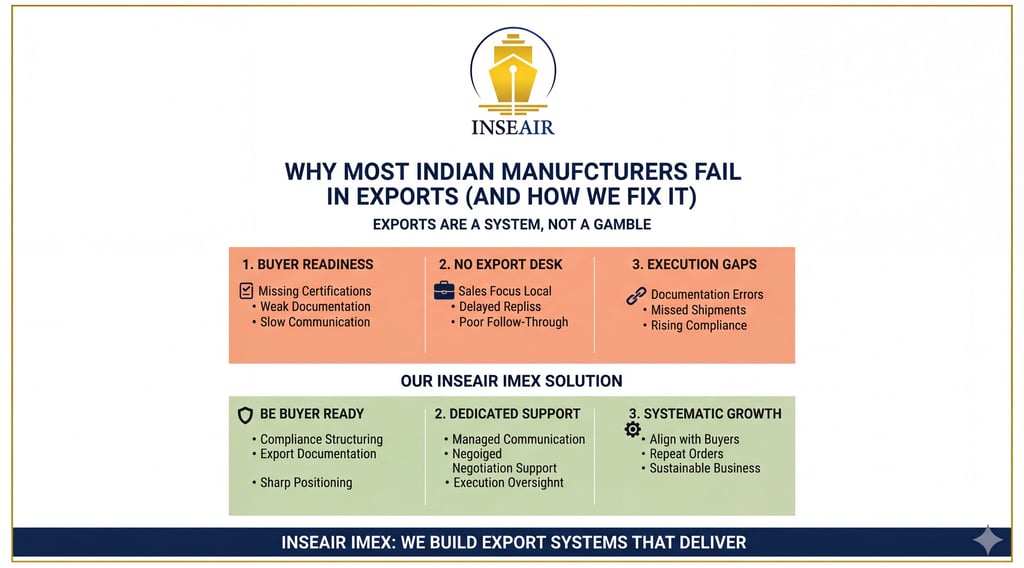
The first major failure point is buyer readiness. Many manufacturers reach out to buyers without being export ready. Certifications are incomplete, compliance documents are scattered, pricing lacks clarity, and communication is slow or inconsistent. Current export data shows that a large share of India’s merchandise exports still comes from a limited pool of repeat exporters, while first time and mid sized manufacturers struggle to convert inquiries into orders. This indicates a structural gap, not a demand problem. Buyers are active, but they screen Indian suppliers aggressively because past experience has taught them where failures usually occur.
The second breakdown is the absence of a dedicated export function. Most factories do not have an inhouse export desk. Export inquiries are handled by production teams or domestic sales staff. This leads to delayed responses, weak negotiations, and poor follow through. Buyers read this as operational risk. Even when orders are secured, execution becomes the third failure point. Documentation errors, logistics misalignment, missed timelines, and lack of shipment visibility damage trust. With rising compliance and traceability requirements from EU, US, and institutional buyers, tolerance for these gaps is shrinking fast. One failed shipment is often enough to lose a buyer permanently.
This is where INSEAIR IMEX operates with a clear and focused role. We act as a dedicated external export desk for Indian manufacturers. Our work starts before buyer outreach. We structure compliance, validate export readiness, sharpen buyer facing positioning, manage communication, support negotiations, and oversee execution. We do not chase random leads or sell false promises. We align manufacturers with how global buyers actually evaluate suppliers. When exports are treated as a disciplined system instead of a gamble, manufacturers move from failed inquiries to repeat orders and from occasional shipments to sustainable global business.