Why Exporting Is Not International Business
Global businesses are built intentionally. They are rarely created accidentally through exports alone.
INSEAIR EXPORT DESK
7/21/20262 min read
The Exporting Trap: Why Your Global Strategy Might Be an Illusion
Walk into any industrial park and ask a CEO if they are global. They will often point to a map with 20 pins. "We export to five continents," they say. It sounds like a success story. Often, it is just a series of errands.
There is a vital difference between exporting and international business. Exporting is an activity. International business is an organizational capability. Confusing the two limits growth for thousands of firms.
Transactions vs. Systems
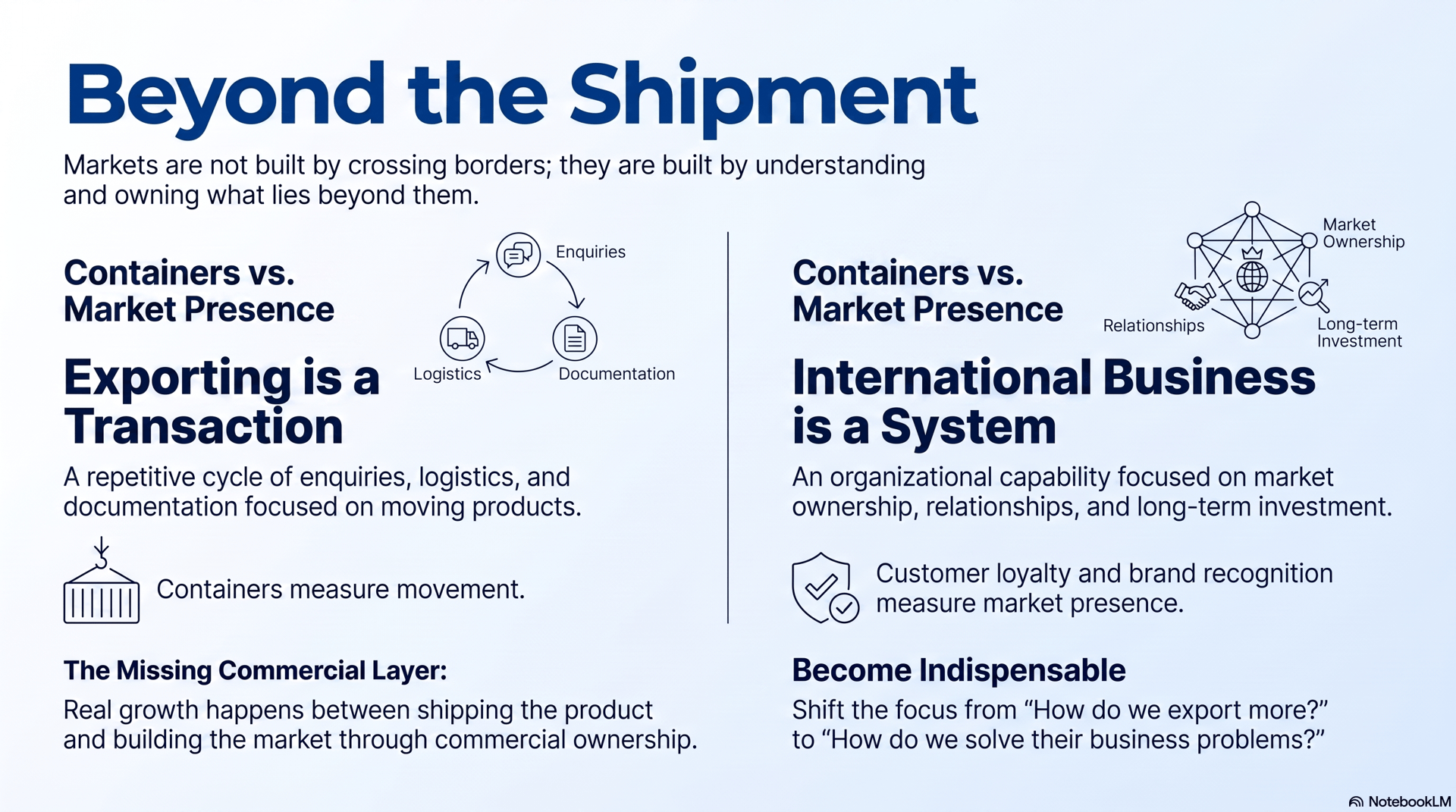
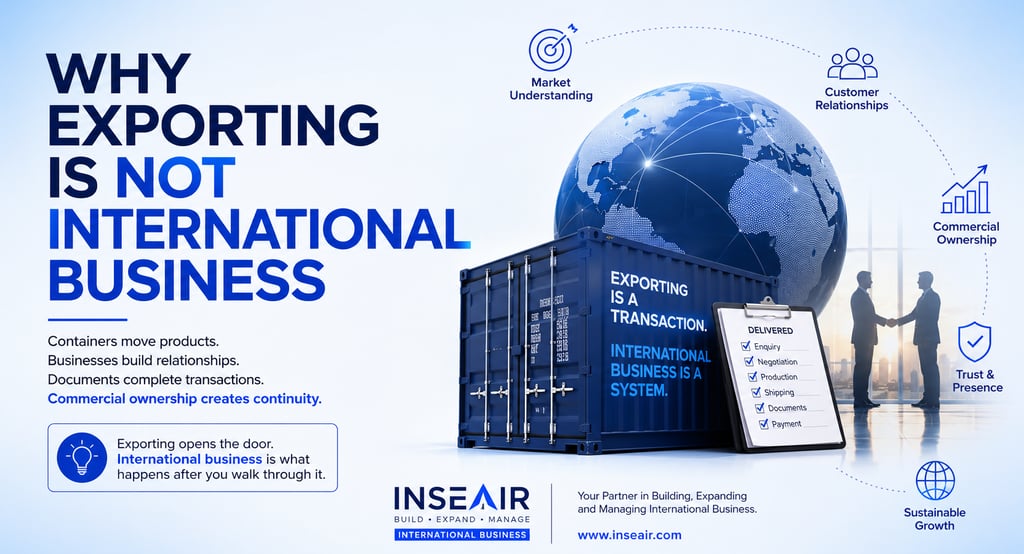
Exporting is a transaction. You receive an enquiry, negotiate a price, ship the product, and get paid. Then, the cycle resets. It is efficient, but it is not a strategy.
International business is a system. It asks different questions: Who owns the customer relationship after delivery? How do we remain visible when there are no active orders? How do we create repeat demand instead of waiting for the next phone call?. Transactions create revenue, but systems create sustainable businesses.
Containers are Not Markets
Many leaders measure success by counting containers. However, containers only measure movement, not presence. You can ship hundreds of units and still have zero influence in a market.
Your pricing may be competitive, but your relationships are often fragile. The real asset isn't the cargo. It is the customer who asks for your brand by name.
The Orchestra Without a Conductor
Think of an international trade operation as an orchestra. Production, finance, and logistics are all skilled players. But without a conductor, there is no harmony. Each department solves its own piece of the puzzle, but no one owns the complete commercial outcome.
This "missing commercial layer" is where growth plateaus. Success requires aligning every function around a single goal: building the market, not just completing the shipment.
The Buyer’s Perspective
International buyers do not just buy products; they buy confidence. They rarely ask about freight rates or shipping schedules. They want to know if you will support them in five years. They want to know if you understand their local challenges.
International business is ultimately the art of reducing uncertainty. Buyers remember how you solve problems long after they forget the price of a shipment.
Shifting the Mindset
To evolve, a business must stop asking, "How do we export more?" and start asking, "How do we become indispensable?". This shift changes everything. Orders become partnerships. Countries become markets. The organization stops chasing demand and starts creating it.
A Final Test for Leadership
CEOs should ask one difficult question: If your orders stopped tomorrow, what would remain? Would you still have trusted relationships and market intelligence? Or would you simply have an empty factory waiting for an enquiry?
True global success belongs to those who take ownership of the entire commercial journey. It requires an integrated capability that connects manufacturers to buyers and reduces friction. Exporting opens the door, but international business is what happens after you walk through it.
That is precisely where INSEAIR positions itself.
Rather than functioning as another export consultant, sourcing agent or trade intermediary, INSEAIR is built around a simple belief: successful international business requires more than executing exports.
It requires an integrated commercial capability that connects manufacturers and international buyers, reduces commercial friction and helps both sides build lasting business relationships.
That philosophy sits at the core of INSEAIR's approach to helping companies build, expand and manage international business, not merely ship products across borders.